

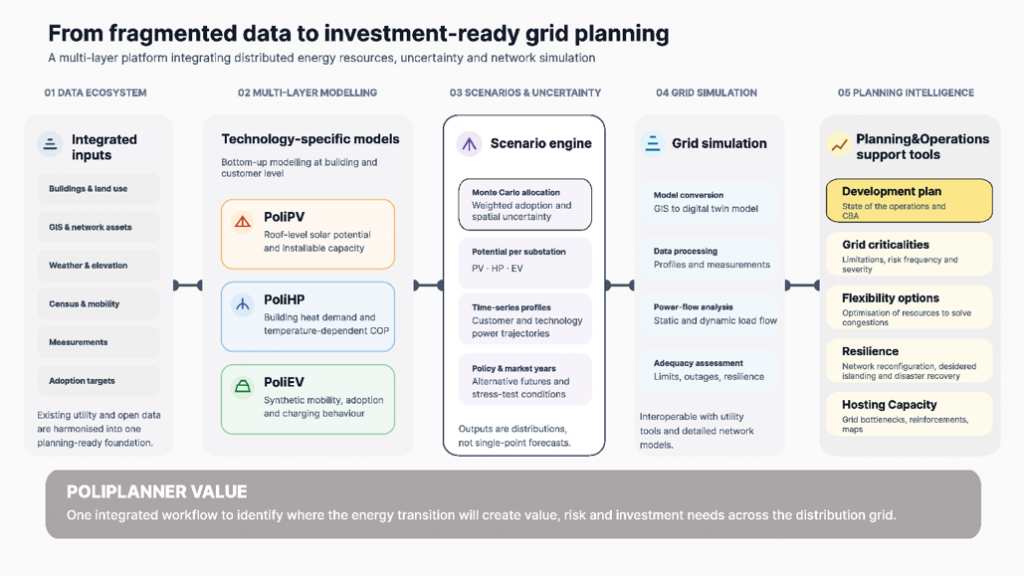
Solar panels, heat pumps and electric vehicles are placing a strain on electric grids faster than utilities can properly plan for them. The effort towards monitoring these drivers is complicated, as data on domestic and utility-scale electrification is insufficient and often late. Grid operators must thus only rely on energy planning, often supported by national-scale and high-level scenarios formulated by agencies.
As operators approach energy planning, the number and scale of difficulties encountered is emerging, mainly for four reasons:
- There is a substantial lack of experience, as this novel task was rarely requested to these companies.
- Grid operators are often (both in the Italian and European landscape) small companies, lacking the resources and technical expertise to create an organic framework capable of gathering and elaborating data and translating the results into grid-compatible scenarios.
- There is no unique methodology nor mandated nor suggested by the National Regulating Authority, who has delegated this to the single companies.
- Lastly, the data required for proper planning efforts is scattered across various systems which are natively incompatible with one another.
PoliPlanner was developed to close this gap. It integrates the outcomes of the energy scenarios simulations with utility proprietary data, such as — GIS records, technical spreadsheets, network digital twin and metering data, returning a clear picture of where the energy transition will have the largest impact. Moreover, the insights and framework gathered inform a basket of procedures accomplishing monitoring, planning and decision-making.
- Strategic investments and decision-making: the detailed outcomes of the investigated scenarios provide insightful techno-financial KPIs and thus allow the evaluation and comparison of grid investments, assisting operators in developing investment strategies.
- Monitoring: several tools perform thorough investigations of the grid present and future status, identifying limitations and action plans to better exploit the resources and operate the system in critical conditions.
- Planning: the planning features are not just devoted to investigate evolution of load and generation, dedicated algorithms are developed in order to quantify the need for flexibility resources, locate them and evaluate which approach (grid reinforcement vs activation of a local market for flexibility) would better manage the grid.
The integrated tools can be applied on large interconnected networks and small islanded grids alike.
The experience matured by the team in assisting and developing solutions for DSOs grants deep knowledge of the needs and complexities customers may face in the day-to-day and long-term planning and exercise of the network. The proposed venture marries explicit attention to low-level facets (software development, solution application and integration) with an expert look at the customer’s point of view and custom needs, providing tailored solutions.
Solar, heat pumps, electric cars
PoliPlanner looks at the three areas reshaping electricity demand today – solar, heating and transport – and models each one of them from the bottom up: customer by customer, building by building, and traces the impact upward through the network.
- PoliPV estimates how much photovoltaic generation each individual roof can host by running a full solar model over high-resolution terrain data that accounts for orientation, shading from neighbouring buildings and the local climate: the elaborated net usable roof surface is translated into installable PV capacity. This tool is effective in identifying potential distributed and utility-scale PV resources.
- PoliHP adopts cutting-edge techniques and tools to estimate the electrical demand for heating. After arranging the buildings dataset into archetypes by climate zone, construction era, use and altitude, it simulates the hourly heat demand of each across a full year, and converts it to electricity demand through an efficiency curve that responds to outdoor temperature.
- PoliEV builds a synthetic population of drivers from mobility and census statistics, combines advanced machine learning models and EV adoption projections to decide which drive an electric vehicle, and works out where and when each one plugs in. Trip start and end points are weighted using open-source data, so a residential street and a public parking lot don’t carry the same likelihood of a charging session. Charger power, driver’s willingness to recharge and, and the overlap between neighbours are all treated as stochastic inputs.
From scenarios to decisions
Knowing the potential and impact of each driver is not the same as predicting what exactly will happen. PoliPlanner takes a policy or market target for a given year and spreads it across the network with a Monte Carlo engine. Instead of scaling everything uniformly, it places one installation at a time, weighted by how attractive each area (and each transformer) is for each driver: available roof space, existing load, building age, altitude, local adoption patterns. The outcome conveys far more information, as each outline is a distribution of values. Every- line, transformer and substation – is assigned a range of loading, and an assessment of how likely it would breach voltage or capacity limits.
These distributions can also be leveraged to turn directly into Hosting Capacity maps, which provide key information on how much more generation or load each network element can withstand before violating standard operating and planning constraints. Additionally, a business case engine can weigh the availability and potential cost of calling resources (generators and loads) for local flexibility against grid reinforcements, and a resilience-focused layer evaluates alternative network configurations to solve congestions. Alternatively, grid reconfigurations could plan to switch to islanding and effectively isolating portions of the network, riding out specific outages or extreme weather events.
Not just a concept
The tools making up PoliPlanner have already been instrumental in the redaction of the development plansof several grid operators, where they were appreciated for the level of detail and thoroughness of investigation. In Italy, the list of the DSOs in charge to publish the grid development plan is available at this link: https://www.arera.it/area-operatori/sviluppo-rtn/sviluppo-reti-di-distribuzione-elettrica. A preliminar release of the proposed PoliPlanner package has been already adopted by the DSOs of Aosta Valley (DEVAL) and by the one of the Trento province (SET).